Fall is easily my favorite time of year. There can be golden days with glorious colors and crisp air.
This fall I feel like I'm fumbling through the days and weeks. I've spent a lot of time on my own, trying to sort out who I am, where I am mentally, and what I should do or leave undone. It isn't easy. It isn't straightforward. I can't get a handle on solid answers, so it can feel like I'm not moving forward. When I run into friends and they ask how I am and what I've been up to... I don't know what to say.
Unvarnished honesty? "I spent all day yesterday in my pajamas, trying to journal or play on the piano to process a memory of an interaction with a teacher in fifth grade."
A skimcoat of spiritual struggle? "Today I've been wrestling with God, but I'm not sure what it's about."
Vague phrases that might pass for wisdom? "Lately it's been about facing unnamed fears and learning deeper trust."
It's excruciating to dig down inside myself and see just. how. deep. some of my self-told lies go. Every layer seems to require a cycle of "grieve-get angry-feel like a slug-find a healthier path-try to take baby steps in a new direction." This gets old really fast, by the way.
I just had a brief walk, and on my way down the sidewalk, I looked at light shining on and through bright leaves, dappled shadows flickering in a slight breeze as I walked. Seeing the play of light and shadow, I realized part of this time's purpose is sunshine & shadow.
Sunshine & Shadow is actually a quilting block pattern that puts light fabric next to dark. It uses contrast to put the lines of that pattern in stark relief. How the quilter arranges multiple blocks is up to them. This section of life that feels like it's been going on forever has had times of great joy and relief ("All those times of feeling incapable of finishing anything are, in part, because it's harder for my brain. I have ADHD.") and moments of shadow. There have been a few shadows this week. Learning that one place I use a gift isn't needed anymore, because another person was hired to do that work in-house. I'm glad for the company's sake--they obviously have a need that can now be met more easily by their own staff--but I also feel... lonely. I don't understand where my gift fits, now.
If life is all shadow or all sunlight, it's easy to categorize it and understand it. "Ah, yes! THIS is good. THAT day was not." Real life is rarely so simple. Joy and junk get mixed together, and sometimes I feel dizzy. For now, I'm choosing to acknowledge shadows that come, even if I don't know what to do about them; I'm trying to see and call out the sunshine. I'm learning that there always seems to be beauty somewhere before me, even if I have to look closely and wait in order to see it.
So I'll head back to working on a puzzle (sunshine--order, clearly defined end state) and watching a series about Egypt (shadow, sort of--death, mummies, men with money seeking archaeological fame). If your day is feeling all shadow, I hope you're able to start looking for the sunshine. I promise it's there. Look longer. Listen harder.
November 03, 2016


October 21, 2016
I Am An Offering
In the Bible, God describes himself as "I Am that I Am."
"I Am" is a confusing name to a child. Pondering it during my life, I've come to know that God is "I Am _______" for me. If I fill in the blank with anything good or true or lovely, God is that. No matter what I lack or who I need in any moment of life, he fills in that blank in the way I need most.
After 28 hours of labor, he was courage for me.
Unable to sleep or read or even think past immense pain, not knowing what was wrong with me so very many mornings at 3 a.m., he was security, comfort, and very present love.
When I've yelled at the ceiling because I don't like what he's doing, he's been a listener, waiting for me to work through my built-up mad.
When I'm hating a part of myself so much, dreading that I'm actually the opposite of all I long to be, he reminds me he created me and delights in me.
A few days ago, I was in my car listening to a worship song by Nathan & Christy Nockels.
You come as You are/ And I come as I am
And grace covers shame
You come in Your power/ And I bow down
And grace covers shame
You come like a flood/ And I'm lost in this
Hallelujah
You come as You are/ And I come as I am
And grace covers all of me
The words overlapped in my head with thoughts of I Am, and I was stunned by a new realization: in the verses in the Bible concerning Jesus, there isn't a single time when he got defensive or argued for why his actions were right or got prickly about someone's reaction to him. He absolutely had emotions; he most certainly spoke hard truth to people at times. He didn't ever make excuses for himself or give any sign that he was insecure about his behavior.
I think Jesus took the time to listen to his Father God, but I know there are times he felt inadequate for what God asked him to do, as in the Garden of Gethsemane. Once Christ stepped into his Father's will, I think he had complete trust that God would provide whatever might be needed to fill in the blanks. Even if Jesus didn't feel ready. Even if things didn't happen the way he wanted.
I will never be perfect. I simply cannot arrive as the be-all and end-all, "Your troubles are over because _I_ am here" in any situation. What I can do is offer myself where God opens doors. I can agree to offer my writing, my musicianship, my creativity, my teaching and cultivate trust that my Abba, my God who is always the I Am, will show up with whatever else is needed.
All I have to do is offer and trust.
Sometimes the simplest things feel the hardest.
"I Am" is a confusing name to a child. Pondering it during my life, I've come to know that God is "I Am _______" for me. If I fill in the blank with anything good or true or lovely, God is that. No matter what I lack or who I need in any moment of life, he fills in that blank in the way I need most.
After 28 hours of labor, he was courage for me.
Unable to sleep or read or even think past immense pain, not knowing what was wrong with me so very many mornings at 3 a.m., he was security, comfort, and very present love.
When I've yelled at the ceiling because I don't like what he's doing, he's been a listener, waiting for me to work through my built-up mad.
When I'm hating a part of myself so much, dreading that I'm actually the opposite of all I long to be, he reminds me he created me and delights in me.
A few days ago, I was in my car listening to a worship song by Nathan & Christy Nockels.
You come as You are/ And I come as I am
And grace covers shame
You come in Your power/ And I bow down
And grace covers shame
You come like a flood/ And I'm lost in this
Hallelujah
You come as You are/ And I come as I am
And grace covers all of me
The words overlapped in my head with thoughts of I Am, and I was stunned by a new realization: in the verses in the Bible concerning Jesus, there isn't a single time when he got defensive or argued for why his actions were right or got prickly about someone's reaction to him. He absolutely had emotions; he most certainly spoke hard truth to people at times. He didn't ever make excuses for himself or give any sign that he was insecure about his behavior.
I think Jesus took the time to listen to his Father God, but I know there are times he felt inadequate for what God asked him to do, as in the Garden of Gethsemane. Once Christ stepped into his Father's will, I think he had complete trust that God would provide whatever might be needed to fill in the blanks. Even if Jesus didn't feel ready. Even if things didn't happen the way he wanted.
I will never be perfect. I simply cannot arrive as the be-all and end-all, "Your troubles are over because _I_ am here" in any situation. What I can do is offer myself where God opens doors. I can agree to offer my writing, my musicianship, my creativity, my teaching and cultivate trust that my Abba, my God who is always the I Am, will show up with whatever else is needed.
All I have to do is offer and trust.
Sometimes the simplest things feel the hardest.
October 19, 2016
Thoroughly Cowed
 I wanted to kill a dog this morning.
We have a large Siberian Husky mix (possibly Malamute, possibly part wolf) at our house. He's a gorgeous beastie, all 85 pounds of him. He's wonderful company for me during the day to talk to, pet, and so forth. He is almost always in need of exercise; this is a large dog who moves fast enough to keep up with a running deer. I've seen him do it.
Today I thought I'd be a good girl and exercise both of us right away. We drove to a small wilderness area nearby that has walking paths, trees, and a small creek. Cody loves to go there, and I've been able to let him off-leash most times we're out there.
Then came this morning.
We were walking--ok, I was walking; he was running--and came to the trail section that runs parallel to a county highway. Cody has been wonderful about obeying me, staying scrupulously to the path when I say, "Path." I don't know if he heard or smelled something new, but in no time at all, he was gone. Up the slope, across the highway, and out of my sight. When I crossed the highway myself, my heart sank.
Cody found cows in the field. If he is part wolf, I feel safe in saying that wolves do not have a herding instinct. A harassing instinct, yes. Herding, no. It was like this dog thought he found large new, interactive toys to play with. He raced up to and around several, seeming to delight in seeing that "these things move, too!" No barking, no howling, no trying to biting or attack (thankfully), but definitely chasing.
Then he swam across the creek and climbed up the other side, because he saw another group of cows! (All through this, mind you, I'm yelling his name in my Army-command voice.) It wasn't until a young male decided to take Cody on that the dog decided the weight difference mattered after all. Suddenly he 'remembered' I was calling him, and he ran back through the creek, across the field, and straight to me without running on the highway again. He was muddy, a massive dog-smile on his face, mouth open, ears back, mud & wet all over... I wanted to kill him.
I leashed him up, marched him in a straight line through the wilderness and right back to our car. Into the car, home in disgrace, and I took him out of the car (still on his leash) and marched him into the laundry room where his bed and dishes are. I left him shut up for a while. He's still pretty somber around me, tentative with his actions and gaze.
For as mad as I might have felt in the moment, I have to honestly recognize the times I go racing off, chasing things larger than me that have the capacity to injure me greatly. Even if it feels fun in the moment, I wonder how much dirt and possible injury God sees when he looks my way.
That insight feels very ham-handed, and I dislike even the appearance of "And here's the bad I do; I should feel bad about the bad I do" slap-my-own-face-before-another-Christian-does-it-for-me response. I sincerely am asking myself some of these questions, though. Are there things I'm chasing that I don't understand, that maybe require more humility? Are there ways I'm trampling all over someone else's thoughts or feelings because it matters more to me that I surrender to my impulse in the moment?
There were moments of seeing Cody fully alive, doing something he understands instinctively. It can be an amazing, beautiful thing. It shouldn't be a goal to kill that in him; the struggle and the discipline are to find ways of using that ability, channeling that energy, in a way that honors life around him, too. That is also my goal for my own misdirected abilities. Someday. So I don't end up chasing cows my whole life. : )
October 17, 2016
Grace in the Gray
Today didn't go the way I wanted it to.
When my family left this morning, I sat at the computer doing family history research. When my husband came home for lunch, four hours later, I was in the same position. Still in my pajamas, sitting cross-legged in our desk chair.
I don't have anything productive in hand from my hours researching. Ideas, time spent learning, information for my mom about her Irish forebears, yes; tangible results for so much time spent in hyperfocus, no.
Partly because of the wet, autumn-dreary, weather, partly because of the information I waded through, and partly because of my feeling that this morning was wasted time, my whole frame aches. It's just how 'me' works for now: any stress ends up resonating through me physically as joint pain and fatigue.
I hoped to follow up on some productive days last week--do some laundry, clean a few rooms, shower--none of those things happened.
Will I choose to keep reminding myself of all I didn't do this morning?
The act of sitting down to write this is a way of choosing grace. I choose to remember who I am: a learner, a puzzle solver, a girl who loves to find family stories. I choose to remember how enthralled I felt as I delved into Irish parish records and immigrant ship descriptions and sailing dates. I choose to be thankful for who I am, for a family who loves me for being me.
Today, so help me, I will choose grace in the middle of gray.
When my family left this morning, I sat at the computer doing family history research. When my husband came home for lunch, four hours later, I was in the same position. Still in my pajamas, sitting cross-legged in our desk chair.
I don't have anything productive in hand from my hours researching. Ideas, time spent learning, information for my mom about her Irish forebears, yes; tangible results for so much time spent in hyperfocus, no.
Partly because of the wet, autumn-dreary, weather, partly because of the information I waded through, and partly because of my feeling that this morning was wasted time, my whole frame aches. It's just how 'me' works for now: any stress ends up resonating through me physically as joint pain and fatigue.
I hoped to follow up on some productive days last week--do some laundry, clean a few rooms, shower--none of those things happened.
Will I choose to keep reminding myself of all I didn't do this morning?
The act of sitting down to write this is a way of choosing grace. I choose to remember who I am: a learner, a puzzle solver, a girl who loves to find family stories. I choose to remember how enthralled I felt as I delved into Irish parish records and immigrant ship descriptions and sailing dates. I choose to be thankful for who I am, for a family who loves me for being me.
Today, so help me, I will choose grace in the middle of gray.
October 16, 2016
Can You Hear Me Now?
There used to be a television commercial for a phone company that featured a man walking around with a phone to his ear, regularly asking, "Can you hear me now?" The question became a trademark for the company, and it cleverly embedded itself in our culture. In those days, signal coverage, the ability to make a phone call, was a lot harder. Wandering five feet from your original position might mean you dropped the call or got your connection back. We fought for that connection. We sought out the tallest places and contorted our bodies in bizarre ways; many phone calls felt like lifelines. We worked hard to keep in communication and hear each other. The commercial and the company's tagline piggybacked on our real-life experience.

Our options for connecting with other human beings have exploded in the last twenty years. Nokia introduced the first phone with internet and email access in 1996. Twenty years later, the number of people who own a smartphone and can check email or surf the internet is in the billions. [As a sidenote, think about this: counting to one billion, saying one number per second without pausing, will take 31.7 years.] Microsoft launched its Encarta program for millions of people to use as an encyclopedia resource in the 1990s; it shuttered the program in 2009. Wikipedia began in 2001; it now has more than 5.2 million articles with more than 850 billion edits. 4.2 billion people send 18.7 billion text messages a day, 560 billion texts a month. Online journals first started in 1994; there were 23 blogs in 1999. Today, there are more than 1.5 billion blogs (including this one) and more than 2.1 million pieces posted online to those blogs in the past twelve hours.
Our tools for connecting have skyrocketed, but I get a feeling of desperation from all of this communication. I feel frustrated if I'm unable to reach someone, but I don't feel as frustrated if I see I missed a call. I confess I usually think, "Drat. Well, they'll try again later."
If there are 18 billion texts sent every day, 2.1 million blogs posted, and 10+ billion phone calls per day (3 billion or more within the U.S. alone)... this is an overwhelming flood, even for 7.3 billion people. We are inundated daily with millions, billions of voices screaming for our attention.
The television commercial is a interesting (if slightly twisted) picture of truth. The industry the commercial represents has inundated our world with options for connecting. We're all talking more; we're all trying to say more; we're all trying to connect more. But we're listening less. We're asking each other, over and over on so many platforms in so many ways: "Can you hear me now?" I've never once asked (or heard) the opposite question: "Do you feel heard?"
I don't even think our lives are more connected, despite our tools. A study in 2014 for the company DHL on phone usage statistics worldwide found that we talk often amongst ourselves, but little to those who are 'unlike' us. Only 3-4% of phone calls were international in 2014; most are domestic. On the internet, roughly 17% of all internet traffic crosses international borders. An estimated 16% of the average person's friends on facebook are foreign; 25% of those we follow on Twitter are foreign. To quote the authors, "Just because we are able to befriend anyone living anywhere on Facebook doesn't mean we will—there is an important distinction between potential connectivity and actual connectedness." [the original study is here]
We're talking more--more topics, more places, more people--but we're listening less.
I think change starts small. I can choose to mute my phone or set it aside (face down, so it doesn't distract me). I can look another person in the eyes during a casual exchange. I can listen to another person talk and use my mind and energy to understand what they're saying, rather than figure out what I'm going to say next. (I'm particularly bad at this.) If I can help even a handful of people feel heard in a day, imagine what 7.3 billion handfuls might do.
Can you hear me now?
October 15, 2016
The Nature of Hope
Since college, I have seen deep truth in the natural world. In clouds, the moon, trees, grains of sand and many, many more instances, I see bone-deep wisdom reflected back to me. These moments of wisdom have given me great peace, security, and insight.
I used to think everyone could read nature this way. After college, I had the privilege of writing the opening for an email newsletter that went out every week to a large group of people centered in the Kansas City metro area. My writing was usually about one or more of these insights that I saw. After several people told me they had never considered such a thing before, I felt more and more grateful for being able to see this hope, these insights of truth, in nature.
This last week I saw a new analogy, and it gave me such hope that I want to share it with others, too.
I had to drive for an appointment, and as I drove alone, I watched the sky. A large front of clouds moved across the windshield. The front wasn't severe enough to birth a large storm, but it was still impressive. I watched the clouds and thought of my sister, who lives on the West Coast. She's mentioned more than once that she misses thunder. Only the plains of the Midwest have the open space necessary to build the massive thunderstorms and fronts that generate hail or even tornadoes. Anyone born and raised in the Midwest knows the change in the air that signals "Storm coming." The worst storms don't accelerate gradually; they explode all at once. The air in front of them feels tense, charged with a feeling that something is coming. The literal 'calm before the storm' isn't peaceful. It's eerie.
The insight that brought me such hope came when these thoughts on thunderstorms overlapped with our political system.
Our nation, for all its flaws, is a wide open space for opinions. Negative, public opinions of our leadership have been aired widely for more than two hundred years. (Trust me. Even George Washington was sneered at in the newspapers of his day.) These wide spaces allow huge storms of opinion to blow up. Every four years, the storms get so big and wreak such havoc that we question if life as we know it will end. This year I've seen multiple voices insisting that if this person (or that, from the opposing side) become President, the apocalypse will come. Right now, I see the storm building. The air is tense. We're dreading the moment the storm breaks, but at the same time we just want this to be over. Many of us are willing to take whatever might be on the other side of the storm, just to get rid of the stress and dread of waiting for it.
Just like storms in the Midwest, the storm breaks and will eventually end. On January 20, 2017, no matter which candidate wins the election, our current president will hand over his position to the winning candidate.
Stop for a moment and allow yourself to realize the amazing nature of that sentence. No other nation in the world has a history of more than 200 years with regular, war-free revolution. The United States has the largest military capacity, the greatest economic sway (though this is changing), and a huge international political impact. These massive juggernauts of power are given to the winning candidate's party every four years. Without fail. Regardless of whether the incoming president aligns with the outgoing president or not. They may have everything in common, or they may not agree on anything. The winning candidate still enters the White House. The outgoing leader still leaves.
The political storms are huge this year. I hate them. I am encouraged greatly to realize that even this line of storms will break, play itself out, and the skies will clear. Period. Knowing that, I truly am willing to face any outcome of the storm's impact. Even if the sky is now green, winds are moaning, and hail is spitting right now, be encouraged: we can survive even these storms.
I used to think everyone could read nature this way. After college, I had the privilege of writing the opening for an email newsletter that went out every week to a large group of people centered in the Kansas City metro area. My writing was usually about one or more of these insights that I saw. After several people told me they had never considered such a thing before, I felt more and more grateful for being able to see this hope, these insights of truth, in nature.
This last week I saw a new analogy, and it gave me such hope that I want to share it with others, too.
I had to drive for an appointment, and as I drove alone, I watched the sky. A large front of clouds moved across the windshield. The front wasn't severe enough to birth a large storm, but it was still impressive. I watched the clouds and thought of my sister, who lives on the West Coast. She's mentioned more than once that she misses thunder. Only the plains of the Midwest have the open space necessary to build the massive thunderstorms and fronts that generate hail or even tornadoes. Anyone born and raised in the Midwest knows the change in the air that signals "Storm coming." The worst storms don't accelerate gradually; they explode all at once. The air in front of them feels tense, charged with a feeling that something is coming. The literal 'calm before the storm' isn't peaceful. It's eerie.
The insight that brought me such hope came when these thoughts on thunderstorms overlapped with our political system.
Our nation, for all its flaws, is a wide open space for opinions. Negative, public opinions of our leadership have been aired widely for more than two hundred years. (Trust me. Even George Washington was sneered at in the newspapers of his day.) These wide spaces allow huge storms of opinion to blow up. Every four years, the storms get so big and wreak such havoc that we question if life as we know it will end. This year I've seen multiple voices insisting that if this person (or that, from the opposing side) become President, the apocalypse will come. Right now, I see the storm building. The air is tense. We're dreading the moment the storm breaks, but at the same time we just want this to be over. Many of us are willing to take whatever might be on the other side of the storm, just to get rid of the stress and dread of waiting for it.
Just like storms in the Midwest, the storm breaks and will eventually end. On January 20, 2017, no matter which candidate wins the election, our current president will hand over his position to the winning candidate.
Stop for a moment and allow yourself to realize the amazing nature of that sentence. No other nation in the world has a history of more than 200 years with regular, war-free revolution. The United States has the largest military capacity, the greatest economic sway (though this is changing), and a huge international political impact. These massive juggernauts of power are given to the winning candidate's party every four years. Without fail. Regardless of whether the incoming president aligns with the outgoing president or not. They may have everything in common, or they may not agree on anything. The winning candidate still enters the White House. The outgoing leader still leaves.
The political storms are huge this year. I hate them. I am encouraged greatly to realize that even this line of storms will break, play itself out, and the skies will clear. Period. Knowing that, I truly am willing to face any outcome of the storm's impact. Even if the sky is now green, winds are moaning, and hail is spitting right now, be encouraged: we can survive even these storms.
October 05, 2016
Soul Jeweler
This morning was horrible.
It shouldn't have been, but it was.
It had no reason to be, but it was anyway.
The reason this morning was horrible was because I tried to avoid God all morning.
My thoughts and emotions have been swirling and storming the last several days, and I couldn't get them settled. Once my family left the house, I thought, "I should journal." Just as quickly, I recoiled. I hemmed and hawed and delayed and dragged my feet and tried to skate past that idea. Why do I keep doing this? What exactly am I afraid of?
I played games on my phone, fully aware I was only treading water on unresolved inner cycling (at best; usually I'm losing even more ground). I reluctantly sat down at my piano, getting close to spending time with God, but still just spinning out what was already inside me. I often have the idea that I have to vomit up 'self' until nothing is left in order to make room for God. This idea is wrong; I know it's wrong, but I still keep returning to that mess of vomit.
Because I promised myself, I went to a local midweek chapel service. The worship songs and message were exactly on point: God gets to be God. He is not and never will be a math equation I understand, let alone one I could solve. He gets to show up when and how he chooses.
One of the worship songs we sang was the song, "Shepherd," by Bethel Music. The lyrics wove into so very many thoughts I have had this past week. Tears run down my cheeks every single time I've hear the song, and I hate crying in front of other people.
When the service was over, I talked with a couple good friends who were there. We talked about where we are now, not where we were yesterday or last week or what a glossy brochure of us would say. Genuine friendships and conversations are among my favorite things in life.
Me? I stated baldly that I despise the speaker (a wonderful friend of many years, greatly used by God to speak truth in love). I didn't mean that I truly hated him, but that I resented his words being just what I needed to hear, even if they weren't what I wanted to hear. I even swore at one of the people I was talking to. Swore. In a sanctuary. Deliberately.
I'm still in a somewhat numb place, but while I was listening to "Shepherd" again (yes, more tears), I thought: "Maybe this is one of my gifts."
Blunt words so often spill from me like untumbled pebbles. There may be incredible insights or deep truth, gems, among those words, but they're so very rough and unfinished...
One of my greatest gifts is how ready I am to simply be me in all my honest, messy brokenness. I know very well that my attempts to polish are pointless. I know, marrow-deep, that God is the only one who gets to be the jeweler of souls, deciding which form will showcase beauty and reflect light most brilliantly.
I don't know what's ahead of me. I'm afraid of it, whatever it is. I don't know why I'm afraid. Today feels like a day to empty my self of its many weights (for the who-knows-how-many-th time) and dump them in front of God. Today is a day for me to choose trust that he'll always find gems worth keeping in me. Today I'm reminding myself to believe he knows best how to shape me.
It shouldn't have been, but it was.
It had no reason to be, but it was anyway.
The reason this morning was horrible was because I tried to avoid God all morning.
My thoughts and emotions have been swirling and storming the last several days, and I couldn't get them settled. Once my family left the house, I thought, "I should journal." Just as quickly, I recoiled. I hemmed and hawed and delayed and dragged my feet and tried to skate past that idea. Why do I keep doing this? What exactly am I afraid of?
I played games on my phone, fully aware I was only treading water on unresolved inner cycling (at best; usually I'm losing even more ground). I reluctantly sat down at my piano, getting close to spending time with God, but still just spinning out what was already inside me. I often have the idea that I have to vomit up 'self' until nothing is left in order to make room for God. This idea is wrong; I know it's wrong, but I still keep returning to that mess of vomit.
Because I promised myself, I went to a local midweek chapel service. The worship songs and message were exactly on point: God gets to be God. He is not and never will be a math equation I understand, let alone one I could solve. He gets to show up when and how he chooses.
One of the worship songs we sang was the song, "Shepherd," by Bethel Music. The lyrics wove into so very many thoughts I have had this past week. Tears run down my cheeks every single time I've hear the song, and I hate crying in front of other people.
When the service was over, I talked with a couple good friends who were there. We talked about where we are now, not where we were yesterday or last week or what a glossy brochure of us would say. Genuine friendships and conversations are among my favorite things in life.
Me? I stated baldly that I despise the speaker (a wonderful friend of many years, greatly used by God to speak truth in love). I didn't mean that I truly hated him, but that I resented his words being just what I needed to hear, even if they weren't what I wanted to hear. I even swore at one of the people I was talking to. Swore. In a sanctuary. Deliberately.
I'm still in a somewhat numb place, but while I was listening to "Shepherd" again (yes, more tears), I thought: "Maybe this is one of my gifts."
Blunt words so often spill from me like untumbled pebbles. There may be incredible insights or deep truth, gems, among those words, but they're so very rough and unfinished...
One of my greatest gifts is how ready I am to simply be me in all my honest, messy brokenness. I know very well that my attempts to polish are pointless. I know, marrow-deep, that God is the only one who gets to be the jeweler of souls, deciding which form will showcase beauty and reflect light most brilliantly.
I don't know what's ahead of me. I'm afraid of it, whatever it is. I don't know why I'm afraid. Today feels like a day to empty my self of its many weights (for the who-knows-how-many-th time) and dump them in front of God. Today is a day for me to choose trust that he'll always find gems worth keeping in me. Today I'm reminding myself to believe he knows best how to shape me.
September 01, 2015
Cinderella Syndrome
I read this morning about martyr-type personalities. Martyrs are those who see all of life as a glass that's half-empty. Plans won't work out, ideas will fail, and everyone would have a better time without them.
I know I have my martyr moments, but it was a cold shock to realize how MUCH of me is martyr. Harder than that was reading what causes martyr behavior: desire for control and a sense their wants don't matter.
Ow.
I grew up thinking my wants didn't matter, and control was something I wanted but didn't have; most control came from my parents, who taught me a lot about authority and respect. The difficulty is that my habits over the years make it hard to accept help. Help means I failed to do it myself. Not feeling heard or listened to by someone I love still sends me into disproportionate panic.
I wondered if there's a Cinderella Syndrome going on in Christian culture. We're supposed to serve. We're supposed to look out for others' interests. We're not supposed to be selfish. We often develop the mindset that experiencing pleasure, doing something just because we want to, is wrong. The only way 'want' is acceptable is if we do all our serving others first, then fit our want into the space that's left. Cinderella Syndrome: once our list of chores is done, THEN we can go to the ball.
I don't know what the right mindset is, but I know my current one is wrong. This outlook makes it nearly impossible to believe that God loves me and wants good for me. This perspective leads me to believe that God wants joy for me, but gives it reluctantly and only if I prove I've worked/done/served/done enough -- whatever 'enough' means.
I think the antidotes for Cinderella Syndrome are these:
1-- Ask for help, Ask for it before I'm at the bottom of a pit flat on my back. Ask for help without offering 'payback' things to compensate the giver. Ask without excuse or justification or lessening of my inadequacy. Receive the help with simple thanks -- not offers that balance the 'need' scale in my head, not fear that all help comes with strings attached, and not shame that I needed help in the first place.
2-- Surrender. Stop trying. The chore list will never end. Laundry will always get dirty again; the dog will need to be walked again, no matter how long you were out this morning. I could always pray for more minutes, read more chapters in my Bible, and volunteer for more serving opportunities. I need to surrender in the moment to whatever God is telling me. I need to surrender control of how anyone else might view me and be willing to have someone else be mad or think I'm foolish for doing or not doing something.
I hate what the Cinderella Syndrome creates, but changing how I think and act can be so very hard.
One day, one hour, one moment, one thought at a time. Jesus, please strengthen me today. Please strengthen all of us; make us aware of your spirit in our ever-present NOW.
I know I have my martyr moments, but it was a cold shock to realize how MUCH of me is martyr. Harder than that was reading what causes martyr behavior: desire for control and a sense their wants don't matter.
Ow.
I grew up thinking my wants didn't matter, and control was something I wanted but didn't have; most control came from my parents, who taught me a lot about authority and respect. The difficulty is that my habits over the years make it hard to accept help. Help means I failed to do it myself. Not feeling heard or listened to by someone I love still sends me into disproportionate panic.
I wondered if there's a Cinderella Syndrome going on in Christian culture. We're supposed to serve. We're supposed to look out for others' interests. We're not supposed to be selfish. We often develop the mindset that experiencing pleasure, doing something just because we want to, is wrong. The only way 'want' is acceptable is if we do all our serving others first, then fit our want into the space that's left. Cinderella Syndrome: once our list of chores is done, THEN we can go to the ball.
I don't know what the right mindset is, but I know my current one is wrong. This outlook makes it nearly impossible to believe that God loves me and wants good for me. This perspective leads me to believe that God wants joy for me, but gives it reluctantly and only if I prove I've worked/done/served/done enough -- whatever 'enough' means.
I think the antidotes for Cinderella Syndrome are these:
1-- Ask for help, Ask for it before I'm at the bottom of a pit flat on my back. Ask for help without offering 'payback' things to compensate the giver. Ask without excuse or justification or lessening of my inadequacy. Receive the help with simple thanks -- not offers that balance the 'need' scale in my head, not fear that all help comes with strings attached, and not shame that I needed help in the first place.
2-- Surrender. Stop trying. The chore list will never end. Laundry will always get dirty again; the dog will need to be walked again, no matter how long you were out this morning. I could always pray for more minutes, read more chapters in my Bible, and volunteer for more serving opportunities. I need to surrender in the moment to whatever God is telling me. I need to surrender control of how anyone else might view me and be willing to have someone else be mad or think I'm foolish for doing or not doing something.
I hate what the Cinderella Syndrome creates, but changing how I think and act can be so very hard.
One day, one hour, one moment, one thought at a time. Jesus, please strengthen me today. Please strengthen all of us; make us aware of your spirit in our ever-present NOW.
January 30, 2015
Can't
I can't face writing this morning.
I can't come up with anything witty to say.
I can't force myself through the present struggles of 'now', the pain that's been with me since July, to sound pulled-together, wise, or over-coming.
I just can't.
Writers are supposed to writ ewhat they know. We're supposed to make writing a discipline, not dependent on whether we want to write, but about putting our butts in the chair consistently, to practice our craft diligently so that when the muse visits, we're ready.
Today I have a pittance.
It feels like an inconsequential offering.
I feel resentful rather than surrendered.
Writing feels forced rather than proffered.
Sometimes faith is expressed in words dredged from a muddy mind, offering up the only crumbs I have, in belief that God does the most when I give him so little.
I can't do less than offer him something.
He extends me his all.
I can't come up with anything witty to say.
I can't force myself through the present struggles of 'now', the pain that's been with me since July, to sound pulled-together, wise, or over-coming.
I just can't.
Writers are supposed to writ ewhat they know. We're supposed to make writing a discipline, not dependent on whether we want to write, but about putting our butts in the chair consistently, to practice our craft diligently so that when the muse visits, we're ready.
Today I have a pittance.
It feels like an inconsequential offering.
I feel resentful rather than surrendered.
Writing feels forced rather than proffered.
Sometimes faith is expressed in words dredged from a muddy mind, offering up the only crumbs I have, in belief that God does the most when I give him so little.
I can't do less than offer him something.
He extends me his all.
January 27, 2015
Powerful Pain
As of this week, I believe in time travel. Physical pain I had last year has returned again, giving me more reason to dislike January and February. Between then and now, I've had three MRIs, a major surgery on my spine, multiple visits with specialists, and so many pills I have a medication organizer that makes me scowl. Only old people have those. I refuse to be an old person.
When I started choosing gratitude several years ago, I began with big things: family, income, shelter, health, sunny days. This last year taught me that even slender flakes can be pure gold. I wondered (and worried) last August that I wouldn't be able to tell which pain was from fibromyalgia and which pain was from degenerative spinal discs. This week I truly have felt thankful that yes, there is a difference, and yes, I know which is which.
I apologize if that's too Pollyanna-optimistic for you; it's hard-fought progress for me to see that and mean it.
Somewhere along the line our Western world got the idea that life and happiness and joy are directly related to how much pain we prevent or remove from daily existence. We are uncomfortable around struggles that have no answers, pain that baffles experts. I disagree with this perspective.
As someone underneath a harrow, here's what I value:
1. Your honesty with me
If you don't understand why this is happening to me, say so. If you're baffled that I could feel grateful, please say that. One of my greatest gifts this week was a friend who told me she was fine with me feeling grateful, but she was going to be mad on my behalf. One of your greatest gifts to someone in pain is your honesty. It helps me feel safe enough with you to be honest, too.
2. Your willingness to listen
I'm not interested in answers. My biggest struggles in life each have stark examples of people (usually acquaintances rather than close friends) who had solutions to my problem. I should just do this. I should just go see that person. I should really start taking/stop eating X. If you haven't walked every step with me, it's a pretty safe bet you're assuming something about me that isn't true. I've felt my heart sink more than once as someone matter-of-factly told me what I should do. None of these answers--and I do mean NONE--helped. Many I had already tried, but the person talking was more interested in being right than they were in listening. You can only meet me where I am if you take time to listen to me and hear my heart.
3. Hearing about you
My struggles consume so much of my day. Distraction from me, from my own ongoing frustrations and doubts, is wonderful. If my pain won't recede enough for me to listen, please trust that I'll find a way to tell you. I haven't forgotten there's a wide world outside of me. I'm not self-centered enough to believe my life is more important than others'. I want to hear about YOU. Your wrestling matches can be just as vexing as mine in any given moment--mine just come in a different form. Don't assume I stopped caring about you.
4. Others' fruit
Most valuable of all are those under their own harrows--people who, like me, have good days and bad. People in pain actually don't talk about their pain much. We dig deeply into honesty. We get angry with God. We don't hand out answers to each other. We listen closely and watch body posture and facial expression. We know without being told when it's a hard day. Even when the hard days are behind us, we don't forget the moment by moment nature of life. We may talk about our own contentment or baffling gratitude in the midst of pain, but we never tell another person how they should feel or respond to theirs. Every life is unique; doesn't it follow that every path to productive purpose would also, then, be unique?
I believe in all of this that pain can be powerful and productive. I'm not saying my pain will do anything for you, but I believe with all my heart that it can be the making of me.
When I started choosing gratitude several years ago, I began with big things: family, income, shelter, health, sunny days. This last year taught me that even slender flakes can be pure gold. I wondered (and worried) last August that I wouldn't be able to tell which pain was from fibromyalgia and which pain was from degenerative spinal discs. This week I truly have felt thankful that yes, there is a difference, and yes, I know which is which.
I apologize if that's too Pollyanna-optimistic for you; it's hard-fought progress for me to see that and mean it.
Somewhere along the line our Western world got the idea that life and happiness and joy are directly related to how much pain we prevent or remove from daily existence. We are uncomfortable around struggles that have no answers, pain that baffles experts. I disagree with this perspective.
As someone underneath a harrow, here's what I value:
1. Your honesty with me
If you don't understand why this is happening to me, say so. If you're baffled that I could feel grateful, please say that. One of my greatest gifts this week was a friend who told me she was fine with me feeling grateful, but she was going to be mad on my behalf. One of your greatest gifts to someone in pain is your honesty. It helps me feel safe enough with you to be honest, too.
2. Your willingness to listen
I'm not interested in answers. My biggest struggles in life each have stark examples of people (usually acquaintances rather than close friends) who had solutions to my problem. I should just do this. I should just go see that person. I should really start taking/stop eating X. If you haven't walked every step with me, it's a pretty safe bet you're assuming something about me that isn't true. I've felt my heart sink more than once as someone matter-of-factly told me what I should do. None of these answers--and I do mean NONE--helped. Many I had already tried, but the person talking was more interested in being right than they were in listening. You can only meet me where I am if you take time to listen to me and hear my heart.
3. Hearing about you
My struggles consume so much of my day. Distraction from me, from my own ongoing frustrations and doubts, is wonderful. If my pain won't recede enough for me to listen, please trust that I'll find a way to tell you. I haven't forgotten there's a wide world outside of me. I'm not self-centered enough to believe my life is more important than others'. I want to hear about YOU. Your wrestling matches can be just as vexing as mine in any given moment--mine just come in a different form. Don't assume I stopped caring about you.
4. Others' fruit
Most valuable of all are those under their own harrows--people who, like me, have good days and bad. People in pain actually don't talk about their pain much. We dig deeply into honesty. We get angry with God. We don't hand out answers to each other. We listen closely and watch body posture and facial expression. We know without being told when it's a hard day. Even when the hard days are behind us, we don't forget the moment by moment nature of life. We may talk about our own contentment or baffling gratitude in the midst of pain, but we never tell another person how they should feel or respond to theirs. Every life is unique; doesn't it follow that every path to productive purpose would also, then, be unique?
I believe in all of this that pain can be powerful and productive. I'm not saying my pain will do anything for you, but I believe with all my heart that it can be the making of me.
December 19, 2014
Creating Crap
Why is the act of creation so hard?
I love the initial feeling when an idea comes. I excel at ideation (though I hate that word; it reeks of marketing manipulation).
I'm horrible at follow-through. Three afghans, in progress for more than a year, will bear witness. My craft closet, gleefully reclaimed from my daughter when she transitioned out of needing a changing table, is chaotic. Think of Monica's messy closet on Friends.
The time following creation is bad for me, too. I'm detail-oriented (can't see the forest because I keep examining the quality of bark on a single tree) and prone to criticism. That moment when creation is done, when I survey the results of my labor... yuck. The gulf between what I pictured and what resulted is horrendously wide, and in that moment after it's done, I want to give it away so I don't have to see it again.
Fast-forward to Christmas. Ideas for gifts? I'm usually good at this. Ideas for gifts that are personal and creative and fit a budget? Harder, but still possible for me. This year, I worked with my brother to record myself playing piano to put on CDs for family members.
I'm listening to the play list of my recordings and holding the completed envelope (with song list, arrangers' names, this picture and suitable gift tag-type info).
I hate it.
I loathe it.
I'm having to fight my inner voices calmly pointing out every missed note, every abrupt tempo change, and then the low, homemade quality of the package.
I'm getting used to this, by the way. I don't like things I've written until 3-6 months after I've written it. I don't know if I will ever enjoy listening to myself play piano. Kind of ironic that "Like a River Glorious" is the song playing right now, the part of the verse with the lyrics, "not a surge a worry/ not a shade of care/ not a blast of hurry/ touch the Spirit there".
My offerings may not feel suitable to me. I don't know how to change those emotions. But I know I can keep offering what I have, refusing to give in to the voices that tell me it would be better not to give at all. Those are lies. I know this because no one has ever given me a gift, from a ring my parents gave me all the way to a pink ribbon bracelet my daughter made out of her pajama pants drawstring, that made me think: "Wow, this is pathetic."
Gifts matter because they say something about the heart of the giver.
I made and gave these with love and a heart longing to offer myself to those I love. Those I know will know that and appreciate the gift.
No matter what I think of the gift's quality.
I love the initial feeling when an idea comes. I excel at ideation (though I hate that word; it reeks of marketing manipulation).
I'm horrible at follow-through. Three afghans, in progress for more than a year, will bear witness. My craft closet, gleefully reclaimed from my daughter when she transitioned out of needing a changing table, is chaotic. Think of Monica's messy closet on Friends.
The time following creation is bad for me, too. I'm detail-oriented (can't see the forest because I keep examining the quality of bark on a single tree) and prone to criticism. That moment when creation is done, when I survey the results of my labor... yuck. The gulf between what I pictured and what resulted is horrendously wide, and in that moment after it's done, I want to give it away so I don't have to see it again.
Fast-forward to Christmas. Ideas for gifts? I'm usually good at this. Ideas for gifts that are personal and creative and fit a budget? Harder, but still possible for me. This year, I worked with my brother to record myself playing piano to put on CDs for family members.
I'm listening to the play list of my recordings and holding the completed envelope (with song list, arrangers' names, this picture and suitable gift tag-type info).
 |
| "Winter Sonata", by Genece Hamby |
I loathe it.
I'm having to fight my inner voices calmly pointing out every missed note, every abrupt tempo change, and then the low, homemade quality of the package.
I'm getting used to this, by the way. I don't like things I've written until 3-6 months after I've written it. I don't know if I will ever enjoy listening to myself play piano. Kind of ironic that "Like a River Glorious" is the song playing right now, the part of the verse with the lyrics, "not a surge a worry/ not a shade of care/ not a blast of hurry/ touch the Spirit there".
My offerings may not feel suitable to me. I don't know how to change those emotions. But I know I can keep offering what I have, refusing to give in to the voices that tell me it would be better not to give at all. Those are lies. I know this because no one has ever given me a gift, from a ring my parents gave me all the way to a pink ribbon bracelet my daughter made out of her pajama pants drawstring, that made me think: "Wow, this is pathetic."
Gifts matter because they say something about the heart of the giver.
I made and gave these with love and a heart longing to offer myself to those I love. Those I know will know that and appreciate the gift.
No matter what I think of the gift's quality.
October 09, 2014
Puzzled by Faith
My husband and I watched a movie last night while the kids were gone. The movie was good, funny, and had many mirror-moments for me as a mom. We enjoyed it, even if it isn't one we'd purchase ourselves. I thought over other movies I've seen from "faith-based" production companies (which are poorer quality, art-wise) and wondered what the difference was for me.
I thought of the movie we watched (which I liked), then compared it to the movie Her, which we've also seen. If you are a conservative Christian, it's unlikely you will understand or enjoy Her--not impossible, but unlikely. I think there are too many places that the stretch would be farther than is helpful. It's not impossible to like Her, though, because we both did. I hurt over the relationships portrayed, the hurts in individual lives, and felt characters made poor decisions. I liked the movie because of how it portrayed the raw honesty of it; Her is a movie that was willing to walk into a problem, present an answer, and stick around to see the messy ends of how that answer played out over time.
"Christian" films don't usually do this. They present flawed characters or messy lives, but there's usually an obvious character somewhere in the cast who's getting it "right" and whose approach will be humbly recognized as the godly view by the end of the movie. This is the difference in quality for me.
I am a Christian. I believe that the God I love and serve is the only God who was, is and will be. I believe he never changes his character. I believe he created me and loves me too much to allow barriers between us--most of them barriers I put in place myself. I do believe he is the answer to everything in my life, but it doesn't mean I'm the character in the movie with all the answers.
When you open a puzzle, the picture on the box (and maybe on a poster inside) tells you what the end will be. That's Christianity. I know how the story will end, and I have some help in piecing it together. Where most people go wrong is believing that picture on the box means they know where each piece goes. No. I still have to sort pieces by color. I still have to work in sections. I still have to put in a lot of time to assemble a complex puzzle. I may not know until the end that a handful of pieces from another puzzle got dumped into mine by the enemy to confuse me.
I get a bad taste in my mouth when books or movies or other Christian art suggest that reading the Bible gives me the ability to pick up a piece and KNOW where it goes. Too often it results in my having a patronizing or pitying tone toward someone puzzling over their present piece. "Those poor people. If only they'd ask Jesus."
Abba, please help me to remember that knowing the picture on the box isn't the same thing as knowing where each piece goes. You've anchored my life in uncertainty so that I can learn to trust in You rather than myself.
I thought of the movie we watched (which I liked), then compared it to the movie Her, which we've also seen. If you are a conservative Christian, it's unlikely you will understand or enjoy Her--not impossible, but unlikely. I think there are too many places that the stretch would be farther than is helpful. It's not impossible to like Her, though, because we both did. I hurt over the relationships portrayed, the hurts in individual lives, and felt characters made poor decisions. I liked the movie because of how it portrayed the raw honesty of it; Her is a movie that was willing to walk into a problem, present an answer, and stick around to see the messy ends of how that answer played out over time.
"Christian" films don't usually do this. They present flawed characters or messy lives, but there's usually an obvious character somewhere in the cast who's getting it "right" and whose approach will be humbly recognized as the godly view by the end of the movie. This is the difference in quality for me.
I am a Christian. I believe that the God I love and serve is the only God who was, is and will be. I believe he never changes his character. I believe he created me and loves me too much to allow barriers between us--most of them barriers I put in place myself. I do believe he is the answer to everything in my life, but it doesn't mean I'm the character in the movie with all the answers.
 |
| 10/4/11 by mcapraro |
I get a bad taste in my mouth when books or movies or other Christian art suggest that reading the Bible gives me the ability to pick up a piece and KNOW where it goes. Too often it results in my having a patronizing or pitying tone toward someone puzzling over their present piece. "Those poor people. If only they'd ask Jesus."
Abba, please help me to remember that knowing the picture on the box isn't the same thing as knowing where each piece goes. You've anchored my life in uncertainty so that I can learn to trust in You rather than myself.
October 07, 2014
Play it Forward
The battles of parenting never cease, from your child's cradle to grave. There are lulls, though, and I'm so, so, so very thankful right now to be between the pitched warfare of toddler/preschool and teen years. I haven't seen the oodles of spare time this fall I thought I would, since my expectations for what I'll get done rarely never match reality (My house will be sanitized! All papers will be ordered and in labeled files! I'll work through college texts and FINALLY understand matrix algebra! -I wish I could tell you this last one was an exaggeration, but no.).
 These kinds of kids are enchanting and delightful. In small doses. Whenever someone offered to take my toddler, I'd push back a bit in warning: "Are you sure? She can be a lot to deal with." If they persisted, I figured it was caveat emptor and they had been forewarned. Once I saw a haggard look on their face or a stunned sort of shellshock, THEN I knew we could talk honestly about whether they were up for watching her again. Sometimes it would take multiple exposures. In the middle of my firefight, it could be so very, very frustrating to have others look surprised that I thought my kid was difficult. I often wanted to protest that I wasn't a bad mom; they just didn't know my child like I did. If they had to spend every day as point person, they'd agree with me! I knew they would.
One of the weekly events I have is because of a dream of mine. Some people dream of vacations in old age, but I dream of being the 85-yr-old woman on the block that preschoolers want to play with. I have it all pictured in my mind: a small tow-head telling his mom in a piping treble that he's headed over to see if Miss Susan can play.
I remember and treasure the adults I knew in childhood who knew how to play. They are my heroes.
A friend nearby is in a position very familiar to me, because I was there just a couple years ago. Single parenting because her husband's often working on the road, two young kids at home with energy and nap schedules that make outings draining, and one of those children being frighteningly smart, curious, energetic, strong-willed, and verbal. Ever had one of those? It's like being on a tilt-a-whirl in a hurricane some days.
These kinds of kids are enchanting and delightful. In small doses. Whenever someone offered to take my toddler, I'd push back a bit in warning: "Are you sure? She can be a lot to deal with." If they persisted, I figured it was caveat emptor and they had been forewarned. Once I saw a haggard look on their face or a stunned sort of shellshock, THEN I knew we could talk honestly about whether they were up for watching her again. Sometimes it would take multiple exposures. In the middle of my firefight, it could be so very, very frustrating to have others look surprised that I thought my kid was difficult. I often wanted to protest that I wasn't a bad mom; they just didn't know my child like I did. If they had to spend every day as point person, they'd agree with me! I knew they would.
These experiences sank into my bones. Seeing someone else in the same predicament made it a no-brainer for me: I get a weekly playdate with her kids. She's still point person. She still has the dirty work. I just know that I'm uniquely positioned to understand her and understand her kids, too! It can be fun when it's just a couple hours in a week. And oh, the difference between 24/7 and 21/7... The day I got a break automatically became my day of worship. I looked forward to that time all week. Monday was doable because Thursday was coming. I got the bliss of setting down the heavy weight I hefted the rest of the week, and because my parenting muscles got a break, they had a chance to rebuild.
I don't believe in karma. I don't even think I'm doing anything terribly hard. My friend probably thinks I'm a saint and her savior and that I hung the moon and walk on water. For me, it's paying it backward in recognition of where I was and how hard that time was. It's about paying it forward so that I CAN be the senior citizen every kid wants to visit. More than anything, it's about encouragement. Sometimes it's nice to know it's possible to survive young children without committing homicide or winding up in prison. You know, the little things in life.
October 01, 2014
Voicing Thoughts
Aretha Franklin released her cover of "Rollin' in the Deep" this week (full album available October 21st); she began singing at age 10 and is still performing at age 72. I marveled today at the power of her voice and what the human voice can do. Whenever I get interested, I usually go looking for more to learn, so... this morning I went looking for information about the human voice.
Following A.W. Tozer's example, I often like to start my learning with looking at Bible verses about the topic. The word 'voice' occurs hundreds of times in the Old and New Testaments, from Jacob's voice when he tricks Isaac to get Esau's blessing to descriptions of voices of angels, the voice of God, and comparisons of the sound of voices to thunder, trumpets, and mighty waters. The Greek word translated 'voice' is phone (foh-nee'), which we still use today in a number of words like telephone, phonetic, and euphonium. Plutarch called phone "that which brings to light upon that which is thought of in the mind." Or, to use Spiros Zodhiates' words, "The voice explains that which one had in his own mind for others... Phone is the cry of the living creature."
When we inhale, our bodies gather oxygen in the lungs, then exchange needed oxygen and unneeded carbon dioxide. Exhaling removes carbon dioxide. That exhaling, when it's controlled and shaped, is how we speak. Air from your lungs is the fuel for speech. Muscles like the diaphragm are the regulator, controlling the rate the air leaves your body; singers train for years to learn proper diaphragm control. Controlled air goes past two flaps of tissue in your airway called your vocal cords. Vocal cord length and shape plus the size of your airway are what determine the pitch of your voice, how high or low it is. You flex and relax throat muscles to control the pitch of your voice, whether singing or speaking. When the airflow is controlled and the pitch is decided, you use your cheeks, tongue, jaw, teeth and lips to turn the air into recognizable patterns. Vowels are shaped airflow; consonants are all about restricting or stopping the airflow.
Most of us learned to talk farther back than we remember. Without thinking about how we do it, we take the thoughts and ideas and feelings inside us, then use air (breath, wind, spirit, ruach, pneuma) to carry those intangible things past our shaping manipulations so they can take shape in someone else's mind. Jesus says in Matthew 12:34 that the mouth speaks from the overflow of the heart.
Beyond that, the human voice is one of the most intimate things about the human body. We identify loved ones by voice alone; we yearn deeply over hearing our name said by someone we love. Darlene Rose once said that no one ever said her name the way her mother did; I know I feel similarly about how my mom says my name. Parents learn to recognize their child's voice across distances, to discern whether a cry is their child or someone else.
This is the kind of relationship and knowledge Jesus talks about when he says in John 10 that sheep follow their shepherd because they know his voice; they will not follow a stranger. Hebrews 3 & 4 plead several times for us to listen to God's voice today rather than hardening our hearts and turning away.
I think of all the speaking and singing voices I can recognize in very short order and how quickly I move from identifying the person to enjoying whatever I might hear. I'm working to recognize God's voice like this. I'm trying to take time alone to be still, to listen, to train my heart and inner ear to become so familiar with him that I could never mistake a stranger for him. I know it will take time.
Following A.W. Tozer's example, I often like to start my learning with looking at Bible verses about the topic. The word 'voice' occurs hundreds of times in the Old and New Testaments, from Jacob's voice when he tricks Isaac to get Esau's blessing to descriptions of voices of angels, the voice of God, and comparisons of the sound of voices to thunder, trumpets, and mighty waters. The Greek word translated 'voice' is phone (foh-nee'), which we still use today in a number of words like telephone, phonetic, and euphonium. Plutarch called phone "that which brings to light upon that which is thought of in the mind." Or, to use Spiros Zodhiates' words, "The voice explains that which one had in his own mind for others... Phone is the cry of the living creature."
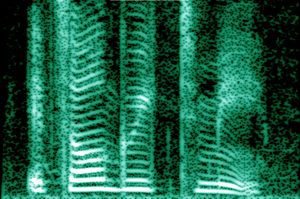 |
| The spectrogram of the human voice reveals its rich harmonic content. |
Most of us learned to talk farther back than we remember. Without thinking about how we do it, we take the thoughts and ideas and feelings inside us, then use air (breath, wind, spirit, ruach, pneuma) to carry those intangible things past our shaping manipulations so they can take shape in someone else's mind. Jesus says in Matthew 12:34 that the mouth speaks from the overflow of the heart.
Beyond that, the human voice is one of the most intimate things about the human body. We identify loved ones by voice alone; we yearn deeply over hearing our name said by someone we love. Darlene Rose once said that no one ever said her name the way her mother did; I know I feel similarly about how my mom says my name. Parents learn to recognize their child's voice across distances, to discern whether a cry is their child or someone else.
This is the kind of relationship and knowledge Jesus talks about when he says in John 10 that sheep follow their shepherd because they know his voice; they will not follow a stranger. Hebrews 3 & 4 plead several times for us to listen to God's voice today rather than hardening our hearts and turning away.
I think of all the speaking and singing voices I can recognize in very short order and how quickly I move from identifying the person to enjoying whatever I might hear. I'm working to recognize God's voice like this. I'm trying to take time alone to be still, to listen, to train my heart and inner ear to become so familiar with him that I could never mistake a stranger for him. I know it will take time.
September 24, 2014
Letting It Go
And lo, the spirit of reason and truth spake unto her, saying, "Guard yourself, for the time of Halloween costumes is upon you."
 I'm not sure when it happened, but Halloween is not the low-key fun holiday I remember as a kid. No one spent $195.50 on a costume to look like a flamingo from head to toe. School parties had jugged Kool-aid to drink and cheap cookies. The amount of candy you raked in had to do with how many houses you were willing to visit. Now... my daughter wants to be Elsa, along with half the child population in the nation. My son wanted to be Yoda. I wished him luck. Then he wanted to be Anakin Skywalker as a Jedi from Episode III. Yes, he's particular.
The problem, my friends, is me. If I do something, I want to do it the right way. It has to meet certain standards, adhere to the ideal, meet a budget, and be darn-near fool-proof so my kids can get them on by themselves at school.
I found costumes that met the budget, the idea, and even pleased my kids (though my son is a Stormtrooper instead; he's happy about it). It was that I realized _I_ was irritated with them for being so easily pleased. Couldn't they see the workmanship was shoddy?! Didn't they know these costumes weren't good representations of what they wanted to be?! How could my offspring have such low standards?
No, the problem is me. If they're pleased, why am I displeased with their costumes? Why am I insisting that what they want isn't good enough for me? When did I suddenly see their lives as a report card for how I'm doing as a parent?
It takes a really poor costume for a kid to comment on how bad another kid's costume is. It takes very little for a parent to think, "Wow, that could have been done better." It also takes very little for a parent to think, "I didn't do NEARLY enough compared with that costume."
I will remind myself of the apostle Paul's words in Philippians 2:12-13:
"Dear friends, you always followed my instructions when I was with you. And now that I am away, it is even more important. Work hard to show the results of your salvation, obeying God with deep reverence and fear. For God is working in you, giving you the desire and the power to do what pleases him."
Work hard to show the results of my salvation... In other words, acknowledge deep within me that I need to Let It Go. Rejoice in the play and fun with my kids; don't allow myself to believe that striving for excellence in my kids' Halloween costumes truly matters at all in the long-range view. It doesn't.
I will also choose to be thankful I found an Elsa dress, even if it isn't exact. If I hadn't found one, I might have tried to make one, and there the temptation to go overboard on perfection might have been too much for me. My family wouldn't have seen me surface for weeks. I would have been researching costume design, dyeing fabrics... it wouldn't have been pretty. At all.
Lastly, I will choose gratitude for how God works in me to change my desires and choices, even in something so small as Halloween costumes.
I'm not sure when it happened, but Halloween is not the low-key fun holiday I remember as a kid. No one spent $195.50 on a costume to look like a flamingo from head to toe. School parties had jugged Kool-aid to drink and cheap cookies. The amount of candy you raked in had to do with how many houses you were willing to visit. Now... my daughter wants to be Elsa, along with half the child population in the nation. My son wanted to be Yoda. I wished him luck. Then he wanted to be Anakin Skywalker as a Jedi from Episode III. Yes, he's particular.The problem, my friends, is me. If I do something, I want to do it the right way. It has to meet certain standards, adhere to the ideal, meet a budget, and be darn-near fool-proof so my kids can get them on by themselves at school.
I found costumes that met the budget, the idea, and even pleased my kids (though my son is a Stormtrooper instead; he's happy about it). It was that I realized _I_ was irritated with them for being so easily pleased. Couldn't they see the workmanship was shoddy?! Didn't they know these costumes weren't good representations of what they wanted to be?! How could my offspring have such low standards?
No, the problem is me. If they're pleased, why am I displeased with their costumes? Why am I insisting that what they want isn't good enough for me? When did I suddenly see their lives as a report card for how I'm doing as a parent?
It takes a really poor costume for a kid to comment on how bad another kid's costume is. It takes very little for a parent to think, "Wow, that could have been done better." It also takes very little for a parent to think, "I didn't do NEARLY enough compared with that costume."
I will remind myself of the apostle Paul's words in Philippians 2:12-13:
"Dear friends, you always followed my instructions when I was with you. And now that I am away, it is even more important. Work hard to show the results of your salvation, obeying God with deep reverence and fear. For God is working in you, giving you the desire and the power to do what pleases him."
Work hard to show the results of my salvation... In other words, acknowledge deep within me that I need to Let It Go. Rejoice in the play and fun with my kids; don't allow myself to believe that striving for excellence in my kids' Halloween costumes truly matters at all in the long-range view. It doesn't.
I will also choose to be thankful I found an Elsa dress, even if it isn't exact. If I hadn't found one, I might have tried to make one, and there the temptation to go overboard on perfection might have been too much for me. My family wouldn't have seen me surface for weeks. I would have been researching costume design, dyeing fabrics... it wouldn't have been pretty. At all.
Lastly, I will choose gratitude for how God works in me to change my desires and choices, even in something so small as Halloween costumes.
September 23, 2014
Buckle up, Scholars!
I am an auto-didact. I love to learn, and I love to seek out new information regarding a very, very broad range of topics. French history? Polish fairy tales? The history of salt and where/why/how it was used and what it meant in cultural references? Connections between electrical wiring and neural networks? I'm your gal. Through analogies, descriptions, and story, I like to make topics interesting to people who weren't interested in them before. History, physiology, language, math, grammar, spiritual truth, literature, art, music, genealogy, and technology can all be fascinating topics if the teacher has a passion for the subject.
Since this is my blog, I want to use those gifts. If you choose to read, I hope some of my topics might help you understand something that wasn't clear before. I can't promise crystal-clear, but maybe the waters will be less muddy. Think CGPGrey, but in words. And perhaps Power Point diagrams. I like diagrams.
This morning my burning passion is for the difference between exegesis and eisegesis. It happens most often when studying the Bible, but it can be used when studying any book or text.
Exegesis is to explain the words as they are written. If the original author sat in your audience and listened to you teach, would they agree with you? Less is more for exegesis (unless you're the author!). Understanding someone else's words often means crossing big gaps in time, cultural understanding, expectations, and language. Gay meant something different to G.K. Chesterton than it does in our time.
Eisegesis is reading a meaning into the text. If you read someone else's words and think to yourself: "Ok, it DEFINITELY means this!" and never, ever reconsider it, be wary. Your mind likely grabbed for the first available meaning (which was probably something that made sense to YOU in YOUR time and in YOUR culture). Eisegesis is using a text to say what you want it to say.
It's wonderful to propose ideas and ask questions. Did Dickens mean to imply such-and-such with this relationship in Dombey & Son? How long would it have taken this character in the Bible to make bread? What alcohol content did wine have in the Middle Ages? Questions are great. They're what help you engage with the story. It's how you answer the questions and what you do with the answers that mark the difference in good learners. Did you assume Dickens' words were meant for someone in your time? (They weren't; he had no idea your world would exist in his lifetime. He wrote the words for HIS world.) Did you assume bread looked the same in Bible times as it does when you make it? (Unless you live in the Middle East and make naan or aish merahrah, it's unlikely.) Did you think wine has existed for thousands of years, so it must be the same? (It hasn't. Wine's composition and how it's made have morphed over time. Not changed completely, but enough so you shouldn't assume.)
Those who bother me most are teachers who move from exegesis and questions straight into eisegesis without giving a heads up when they crossed the line between the two. "We don't know what this name means for sure. This gives us a little freedom in imagining the meaning. Since we don't know what the name means..." NO. No, no, no, no, NO. That went from "we don't know for sure" to "we don't know at all" in less than two sentences. The teacher has now shifted their weight of teaching onto something that was just an idea a moment ago. This is a hard thing to catch if you're not looking for it. Persuasive teachers often fall into this trap. They find a meaning that could mean this... y'know, it works WELL if it means this... it DOES mean this!
No it doesn't. Stick with it COULD mean this.
If a teacher tells you they KNOW what something means and it can only mean this, they better have the credentials you would expect for an expert in a very narrow field with years of experience. People with that kind of knowledge don't have to throw their weight around. Their knowing is usually quieter and assured; they're less likely to argue because they don't need to.
First rule of learning: Always ask yourself if you agree with what you're being taught. Is this information supported or contradicted by what you've learned elsewhere? I can't think of a single person in the world with whom I agree with about everything. That includes my husband, my parents, my children, my counselors, and yes, trusted teachers.
And that includes me! If you have questions for me about what I say, please ask! If you think I said something wrong, please engage with me about it. If you don't understand something and would like to learn more, let me know what the topic is and I'll do my best to go find out and share what I find.
Learning from people is best when it's a conversation, not a monologue.
Since this is my blog, I want to use those gifts. If you choose to read, I hope some of my topics might help you understand something that wasn't clear before. I can't promise crystal-clear, but maybe the waters will be less muddy. Think CGPGrey, but in words. And perhaps Power Point diagrams. I like diagrams.
This morning my burning passion is for the difference between exegesis and eisegesis. It happens most often when studying the Bible, but it can be used when studying any book or text.
Exegesis is to explain the words as they are written. If the original author sat in your audience and listened to you teach, would they agree with you? Less is more for exegesis (unless you're the author!). Understanding someone else's words often means crossing big gaps in time, cultural understanding, expectations, and language. Gay meant something different to G.K. Chesterton than it does in our time.
Eisegesis is reading a meaning into the text. If you read someone else's words and think to yourself: "Ok, it DEFINITELY means this!" and never, ever reconsider it, be wary. Your mind likely grabbed for the first available meaning (which was probably something that made sense to YOU in YOUR time and in YOUR culture). Eisegesis is using a text to say what you want it to say.
It's wonderful to propose ideas and ask questions. Did Dickens mean to imply such-and-such with this relationship in Dombey & Son? How long would it have taken this character in the Bible to make bread? What alcohol content did wine have in the Middle Ages? Questions are great. They're what help you engage with the story. It's how you answer the questions and what you do with the answers that mark the difference in good learners. Did you assume Dickens' words were meant for someone in your time? (They weren't; he had no idea your world would exist in his lifetime. He wrote the words for HIS world.) Did you assume bread looked the same in Bible times as it does when you make it? (Unless you live in the Middle East and make naan or aish merahrah, it's unlikely.) Did you think wine has existed for thousands of years, so it must be the same? (It hasn't. Wine's composition and how it's made have morphed over time. Not changed completely, but enough so you shouldn't assume.)
Those who bother me most are teachers who move from exegesis and questions straight into eisegesis without giving a heads up when they crossed the line between the two. "We don't know what this name means for sure. This gives us a little freedom in imagining the meaning. Since we don't know what the name means..." NO. No, no, no, no, NO. That went from "we don't know for sure" to "we don't know at all" in less than two sentences. The teacher has now shifted their weight of teaching onto something that was just an idea a moment ago. This is a hard thing to catch if you're not looking for it. Persuasive teachers often fall into this trap. They find a meaning that could mean this... y'know, it works WELL if it means this... it DOES mean this!
No it doesn't. Stick with it COULD mean this.
If a teacher tells you they KNOW what something means and it can only mean this, they better have the credentials you would expect for an expert in a very narrow field with years of experience. People with that kind of knowledge don't have to throw their weight around. Their knowing is usually quieter and assured; they're less likely to argue because they don't need to.
First rule of learning: Always ask yourself if you agree with what you're being taught. Is this information supported or contradicted by what you've learned elsewhere? I can't think of a single person in the world with whom I agree with about everything. That includes my husband, my parents, my children, my counselors, and yes, trusted teachers.
And that includes me! If you have questions for me about what I say, please ask! If you think I said something wrong, please engage with me about it. If you don't understand something and would like to learn more, let me know what the topic is and I'll do my best to go find out and share what I find.
Learning from people is best when it's a conversation, not a monologue.
September 19, 2014
Energizer Rabbit on Crack
If you're alone and making siren noises to yourself while driving, purely because the sound and feeling of making that sound interest you, something is wrong.
Today has been insane, and it's completely my brain's fault. My thoughts have been scattered and insanely high-energy. Think free-form popcorn. For hours. Even when no one's there to keep an eye on it.
I took my Ritalin like I should have, and maybe I shouldn't have had two cups of high-octane coffee, but wow... I wrote my daughter's teacher a note this morning to let the teacher know that my girl has been high-energy for the last 12-18 hours. I called my husband before he came home for lunch to warn him about me. "Hi. Before you come home, you should know I am NOT restful to be around right now!"
Talking to oneself doesn't have to mean craziness, but my solitary chatter today has been... scary... even for me, the one who's DOING the chatter.
"LAAAAAAAA!!!!!!! -Ok, that's weird. Why am I making these noises? No idea, but God, I hope you're listening, because I don't think _I_ am right now. Why are just those leaves turning red on that tree now? Wow, that's a big tractor. I wonder if it's the caffeine that's doing this to me or the Ritalin or the sugar in the creamer I used. I wonder what the difference in chemical composition is from Ritalin to caffeine to sugar -- I should look that up in my psychopharmacology textbook when I get home. How soon should I start the meatloaf? I need to bake brownies first--ooh! I should add those white chocolate chips to the batter! and butterscotch ice cream sauce! Did I actually finish my bible study lesson? I wonder if the Hebrew word for 'lily' changes to another Hebrew word if you insert the he letter in the middle. I spent quite a bit of the grocery money for this week already, and it's mostly for just one meal; I should know better than that. Nope, that's not toilet paper rolled over fresh tar, it's just newly-repainted white lines for parking spaces. WooooOOOOOOoooo... wooooOOOOOOOooooo... Making siren noises while I'm by myself is DEFINITELY not normal. I'm nearly freaking-forty! I should be more mature than that" and on and on and on.
You can't possibly read that paragraph as fast as the thoughts came into my head and out my mouth. It was playing at higher than 45 rpms. Mickey Mouse-gibberish speed.
I'm trying to direct this energy into things that aren't harmful and aren't bothersome to other people. When I can, I'm trying to use it productively. I did make the pan of brownies. I've made two meatloaves from scratch (one for tonight, one for the freezer). I've planned out the timelines that will work for meatloaf, mashed potatoes, homemade gravy, and vegetable to be done in time for supper at 5:30. I made myself sit down to talk with my husband when he was home because I knew I would feel guilty later if I didn't--and I also knew that I WILL need rest periods, even if it feels like I'm the Energizer bunny on crack right now.
I don't know the cause of my mental state today. I don't know how to stop it or what good purpose it could possibly serve. Sometimes I feel broken, the questionable relative that just has times of behaving strangely.

I'll be glad when the tilt-a-whirl thoughts end as this is NOT a fun ride to endure. BUT. I will refuse to believe I am fatally damaged. I will choose to believe God is neither surprised nor appalled by my internal state. I will remind myself that today, too, shall pass.
And maybe tomorrow I will be calm again.
Today has been insane, and it's completely my brain's fault. My thoughts have been scattered and insanely high-energy. Think free-form popcorn. For hours. Even when no one's there to keep an eye on it.
I took my Ritalin like I should have, and maybe I shouldn't have had two cups of high-octane coffee, but wow... I wrote my daughter's teacher a note this morning to let the teacher know that my girl has been high-energy for the last 12-18 hours. I called my husband before he came home for lunch to warn him about me. "Hi. Before you come home, you should know I am NOT restful to be around right now!"
Talking to oneself doesn't have to mean craziness, but my solitary chatter today has been... scary... even for me, the one who's DOING the chatter.
"LAAAAAAAA!!!!!!! -Ok, that's weird. Why am I making these noises? No idea, but God, I hope you're listening, because I don't think _I_ am right now. Why are just those leaves turning red on that tree now? Wow, that's a big tractor. I wonder if it's the caffeine that's doing this to me or the Ritalin or the sugar in the creamer I used. I wonder what the difference in chemical composition is from Ritalin to caffeine to sugar -- I should look that up in my psychopharmacology textbook when I get home. How soon should I start the meatloaf? I need to bake brownies first--ooh! I should add those white chocolate chips to the batter! and butterscotch ice cream sauce! Did I actually finish my bible study lesson? I wonder if the Hebrew word for 'lily' changes to another Hebrew word if you insert the he letter in the middle. I spent quite a bit of the grocery money for this week already, and it's mostly for just one meal; I should know better than that. Nope, that's not toilet paper rolled over fresh tar, it's just newly-repainted white lines for parking spaces. WooooOOOOOOoooo... wooooOOOOOOOooooo... Making siren noises while I'm by myself is DEFINITELY not normal. I'm nearly freaking-forty! I should be more mature than that" and on and on and on.
You can't possibly read that paragraph as fast as the thoughts came into my head and out my mouth. It was playing at higher than 45 rpms. Mickey Mouse-gibberish speed.
I'm trying to direct this energy into things that aren't harmful and aren't bothersome to other people. When I can, I'm trying to use it productively. I did make the pan of brownies. I've made two meatloaves from scratch (one for tonight, one for the freezer). I've planned out the timelines that will work for meatloaf, mashed potatoes, homemade gravy, and vegetable to be done in time for supper at 5:30. I made myself sit down to talk with my husband when he was home because I knew I would feel guilty later if I didn't--and I also knew that I WILL need rest periods, even if it feels like I'm the Energizer bunny on crack right now.
I don't know the cause of my mental state today. I don't know how to stop it or what good purpose it could possibly serve. Sometimes I feel broken, the questionable relative that just has times of behaving strangely.
I'll be glad when the tilt-a-whirl thoughts end as this is NOT a fun ride to endure. BUT. I will refuse to believe I am fatally damaged. I will choose to believe God is neither surprised nor appalled by my internal state. I will remind myself that today, too, shall pass.
And maybe tomorrow I will be calm again.
September 17, 2014
Still...
This season of life is new to me. Both of my children are in school, and there are gaps of time in the day that never used to exist. Time to breathe, time to finish drinking an entire cup of coffee before it gets cold, time to tidy a house after the morning melee, and (wonder of wonders) a long stretch of time that the house remains tidy.
By nature I'm an ambivert. I can be social, but I also welcome silence, solitude, and the space to ponder and process whatsoever my mind chooses. The last several years have had many interruptions, questions, disruptions, interventions, admonitions, and instructions, but precious little solitude. I fell in love all over again with my husband when, as I cautioned him not to expect much to change around the house these first few weeks, he said, "I don't expect anything to change for more than a month! You have close to a decade of solitude to make up for."

This is only my third week with regular silences, and I'm learning some hard truths about myself and the world I inhabit. I am learning that we dislike, resist, and even FIGHT stillness.
A movie quote from "The Sound of Music" says that a life of activity suggests a life filled with purpose. Do I resist being still because I fear that it means my life has no active purpose? Have I fallen in the trap of believing my value is equal to my productivity?
It is HARD to be still. Hard to hold myself in check and refrain from acting simply to be active. I'm somewhat dismayed at how quickly a week can fill without any deliberate effort on my part to make it full. It is far more difficult to keep time open. Open time requires actively resisting requests and invitations, learning to say the dreaded word "no" to what is good, sincerely believing that saying "no" can leave me available for what is best in the long run.
When I woke up this morning, my day had a blank holiness of six hours' time. Two of those hours were gone in a flash, with little say-so from me. And yet... it was because so many hours were open that _I_ was open to where the moment might lead. My margins are wider now than they have ever been. I have more time, so I resent things that take time less--while fighting a good fight to maintain deep margins.
Still... still I am waiting. Still, I work to cultivate a listening heart. Still, I have the conviction that more is coming. Still, I enact my belief that there is more beyond me and my activity. Still, I am willing to wait, to halt my action until such a time as I truly am needed.
Today I am praying that my heart will learn to cultivate and crave stillness.
By nature I'm an ambivert. I can be social, but I also welcome silence, solitude, and the space to ponder and process whatsoever my mind chooses. The last several years have had many interruptions, questions, disruptions, interventions, admonitions, and instructions, but precious little solitude. I fell in love all over again with my husband when, as I cautioned him not to expect much to change around the house these first few weeks, he said, "I don't expect anything to change for more than a month! You have close to a decade of solitude to make up for."
This is only my third week with regular silences, and I'm learning some hard truths about myself and the world I inhabit. I am learning that we dislike, resist, and even FIGHT stillness.
A movie quote from "The Sound of Music" says that a life of activity suggests a life filled with purpose. Do I resist being still because I fear that it means my life has no active purpose? Have I fallen in the trap of believing my value is equal to my productivity?
It is HARD to be still. Hard to hold myself in check and refrain from acting simply to be active. I'm somewhat dismayed at how quickly a week can fill without any deliberate effort on my part to make it full. It is far more difficult to keep time open. Open time requires actively resisting requests and invitations, learning to say the dreaded word "no" to what is good, sincerely believing that saying "no" can leave me available for what is best in the long run.
When I woke up this morning, my day had a blank holiness of six hours' time. Two of those hours were gone in a flash, with little say-so from me. And yet... it was because so many hours were open that _I_ was open to where the moment might lead. My margins are wider now than they have ever been. I have more time, so I resent things that take time less--while fighting a good fight to maintain deep margins.
Still... still I am waiting. Still, I work to cultivate a listening heart. Still, I have the conviction that more is coming. Still, I enact my belief that there is more beyond me and my activity. Still, I am willing to wait, to halt my action until such a time as I truly am needed.
Today I am praying that my heart will learn to cultivate and crave stillness.
September 16, 2014
Trust the Joy
I looked at the clock and realized I had less than an hour before my kids would crash through the door after school, so I did what any mom in her right mind would do: I made myself a horrendously large cup of chocolate milk.
There's no one here to cry foul, no one to monitor my syrup usage, and no one to whom I must explain my actions. How is it more parents don't do this?
On the one hand, I could see it as selfishness cropping up where I should have learned selfLESSness by now. I prefer to see it as evidence of my having kept the heart of child.
Have you forgotten? Do you remember the delight if your mom broke the rules and let you have ice cream for breakfast? Or a candy lunch? Or deciding to have the family eat supper in the blanket tent you made in the living room? Do you remember the fascination of seeing something with new eyes and wondering EVERYTHING about it? You had no stored knowledge or ready reference for what was in front of you, so you tried to absorb everything you could about it, whether it was a flower, a new person who was funny, a new story, or a fascinating bug on the sidewalk at your feet. You'd even crouch down, push closer, and squeeze in so you could see better, absorb more.
Have you forgotten?
Where is your joy these days? Is it joy you feel when you complete a job that's been hanging over your head? Is it a joy to see someone catch a spark you lit in hope? Is it delight you feel when you're fully present, all-the-way-up-to-your-elbows in and focused on whatever's before you? Are you able to set aside your to-dos to be fascinated by what you thought was familiar when it shows up on the wrong timetable and out of place? Can you set aside your tasks and grant the time for questions to come? What is that? Why does it look/taste/smell/feel/behave that way? How does it react if you touch it? chase it? try to hold it? How does it change?
It takes time for the questions to come if it's been a while since you gave them the space to form.
If the questions feel silly or hard to force, be near a child and be willing to listen. They ask questions as simply as breathing. The questions may seem ridiculous to an adult mind, but if you're willing to wait and ponder the question, you might remember...
You might remember how hard it was to wait. You might remember the breath-taking wonder the first time you saw someone turn a balloon into the shape you requested. You just might remember how important and sincere your question was and how it hurt when the adults just laughed instead of answering. If you're willing to push into the struggles of memories from your childhood, and you're willing to stay in the frustration a while, you might get back the joy.
The joy of finding out there's no school today because of the snow that made your mom's shoulders slump. The joy of finding your very favorite book is back on the library shelf, even if you've read it so many times you have it memorized; you remember how familiar things can be as wonderful as finding old friends. You'll get back the joy and relaxing feeling of comfort that came from burying your nose in a favorite blanket or pillow or stuffed friend. You might even get back the hedonistic joy of gulping down a carafe of chocolate milk without any grown-ups finding out you did it.
And getting back these joys is worth whatever price you might have to pay.
Now please excuse me. I need to go gulp my milk in less than 10 minutes!
There's no one here to cry foul, no one to monitor my syrup usage, and no one to whom I must explain my actions. How is it more parents don't do this?
On the one hand, I could see it as selfishness cropping up where I should have learned selfLESSness by now. I prefer to see it as evidence of my having kept the heart of child.
Have you forgotten? Do you remember the delight if your mom broke the rules and let you have ice cream for breakfast? Or a candy lunch? Or deciding to have the family eat supper in the blanket tent you made in the living room? Do you remember the fascination of seeing something with new eyes and wondering EVERYTHING about it? You had no stored knowledge or ready reference for what was in front of you, so you tried to absorb everything you could about it, whether it was a flower, a new person who was funny, a new story, or a fascinating bug on the sidewalk at your feet. You'd even crouch down, push closer, and squeeze in so you could see better, absorb more.
Have you forgotten?
Where is your joy these days? Is it joy you feel when you complete a job that's been hanging over your head? Is it a joy to see someone catch a spark you lit in hope? Is it delight you feel when you're fully present, all-the-way-up-to-your-elbows in and focused on whatever's before you? Are you able to set aside your to-dos to be fascinated by what you thought was familiar when it shows up on the wrong timetable and out of place? Can you set aside your tasks and grant the time for questions to come? What is that? Why does it look/taste/smell/feel/behave that way? How does it react if you touch it? chase it? try to hold it? How does it change?
It takes time for the questions to come if it's been a while since you gave them the space to form.
If the questions feel silly or hard to force, be near a child and be willing to listen. They ask questions as simply as breathing. The questions may seem ridiculous to an adult mind, but if you're willing to wait and ponder the question, you might remember...
You might remember how hard it was to wait. You might remember the breath-taking wonder the first time you saw someone turn a balloon into the shape you requested. You just might remember how important and sincere your question was and how it hurt when the adults just laughed instead of answering. If you're willing to push into the struggles of memories from your childhood, and you're willing to stay in the frustration a while, you might get back the joy.
The joy of finding out there's no school today because of the snow that made your mom's shoulders slump. The joy of finding your very favorite book is back on the library shelf, even if you've read it so many times you have it memorized; you remember how familiar things can be as wonderful as finding old friends. You'll get back the joy and relaxing feeling of comfort that came from burying your nose in a favorite blanket or pillow or stuffed friend. You might even get back the hedonistic joy of gulping down a carafe of chocolate milk without any grown-ups finding out you did it.
And getting back these joys is worth whatever price you might have to pay.
Now please excuse me. I need to go gulp my milk in less than 10 minutes!
September 15, 2014
My Fear of My Girl
A friend of my heart wrote a post about her fears in having a daughter. I love her writing voice, and many of her phrases tugged on resonant heartstrings in me, so... despite the on-going litany of tasks and to-dos and shoulds and "Good Things That I Ought to be Doing Instead" [please tell me I'm not the only one who has these] I've run to my keyboard to think through some fears myself.
I knew from the moment I married that, if I had children, odds were heavily weighted in favor of having a child like I was. We have a clone of me (or as close as we'll get outside a laboratory) in our heart-winning hurricane of a girl. She is mature for her age in many ways, but she still brings me fears aplenty.
I fear being her primary female role model, because I still get it wrong so often.
I fear looking at her and finding new things that need fixing in me.
I fear walking through familiar prisons again with her--and forgetting how I got out the first time.
I fear seeing her bypass some of my prisons and (heaven help me) possibly resenting her the tiniest bit for escaping what I did not.
I fear feeling my heart sink as I watch her get bewildered by the same things that confused me.
I fear that my role of comforter and rejuvenator will atrophy or be destroyed as she gets older.
I fear that she frames who she will be without me or in spite of me.
 My daughter, more than my son, reminds me of who I have been and who I am. She is as painful and frustrating a mirror of me as heaven could shape. In wrestling with how to help or direct her (or simply outlast her), I have often thought wildly that _I_ of all people should know what to do! I've had more time with her than anyone else on the planet has. 2300+ days. 55,000+ hours. So often she leaves me staggered and speechless. She unwittingly shows me how often I don't have the answers.
I want so many good things for her. I know how hard the road could be ahead. It feels like cheating sometimes to remind myself that she belongs to God first, so HE is the one who directs her life, and it's okay if I don't have the answers because he does.
I'm trying to 'be' when I'm with her in ways that leave me feeling vulnerable. Answering questions she asks me just after I get out of the shower. Being honest about my struggles and insecurities. Asking for her help without leaning on her in ways she isn't meant to uphold me.
If it's hard to be a woman in all the ways that are best and brave, it's a billion times harder to be that and encourage an open floor for questions from your preschool audience as you do it.
For now... it's the best way I know to help her learn to be whoever she might be.
I knew from the moment I married that, if I had children, odds were heavily weighted in favor of having a child like I was. We have a clone of me (or as close as we'll get outside a laboratory) in our heart-winning hurricane of a girl. She is mature for her age in many ways, but she still brings me fears aplenty.
I fear being her primary female role model, because I still get it wrong so often.
I fear looking at her and finding new things that need fixing in me.
I fear walking through familiar prisons again with her--and forgetting how I got out the first time.
I fear seeing her bypass some of my prisons and (heaven help me) possibly resenting her the tiniest bit for escaping what I did not.
I fear feeling my heart sink as I watch her get bewildered by the same things that confused me.
I fear that my role of comforter and rejuvenator will atrophy or be destroyed as she gets older.
I fear that she frames who she will be without me or in spite of me.
My daughter, more than my son, reminds me of who I have been and who I am. She is as painful and frustrating a mirror of me as heaven could shape. In wrestling with how to help or direct her (or simply outlast her), I have often thought wildly that _I_ of all people should know what to do! I've had more time with her than anyone else on the planet has. 2300+ days. 55,000+ hours. So often she leaves me staggered and speechless. She unwittingly shows me how often I don't have the answers.I want so many good things for her. I know how hard the road could be ahead. It feels like cheating sometimes to remind myself that she belongs to God first, so HE is the one who directs her life, and it's okay if I don't have the answers because he does.
I'm trying to 'be' when I'm with her in ways that leave me feeling vulnerable. Answering questions she asks me just after I get out of the shower. Being honest about my struggles and insecurities. Asking for her help without leaning on her in ways she isn't meant to uphold me.
If it's hard to be a woman in all the ways that are best and brave, it's a billion times harder to be that and encourage an open floor for questions from your preschool audience as you do it.
For now... it's the best way I know to help her learn to be whoever she might be.
Subscribe to:
Posts (Atom)